
Cataract Surgery

What is a cataract?
The natural “lens” in the eye focuses the light on objects so that we can see clearly. Like the lens in a camera, it brings our world into focus at different distances. As we age, the natural lens becomes cloudy, discolored, and stiffer, which is then called a “cataract.”
The procedure involves the removal of the cloudy natural lens, and replacing it with an artificial lens. Most patients opt for a monofocal lens, which can be adjusted to give either distance or near vision. Glasses may then be prescribed as necessary. Advance technology lenses include toric lenses, which can reduce astigmatism or multifocal lenses, which allow for both distance and near vision, usually without the need for glasses.
What is cataract surgery?
Surgery is typically painless, as incisions are less than 3 millimeters in size in the front, clear part of the eye called the cornea. An instrument is inserted and uses sound waves to break up the cataract and vacuum it from the eye. A new artificial lens (intraocular lens, or IOL) is put in its place. At the surgical center, you will get an IV for medication to relax you during surgery, and most patients only notice a few lights changing colors. During surgery, your cataract will be removed, and a new plastic-type lens will be put in its place. The surgery itself is about thirty minutes or less, and you will go home shortly after.
When do I need cataract surgery?
Even if you have been diagnosed with cataracts, you are not required to have cataract surgery. When you feel your decreased vision is affecting your day to day life, it is time to consider cataract surgery.
Lenses for your lifestyle
During your pre-operative visit, you will have measurements of the curvature and length of your eye to help calculate the correct power lens to be placed in your eye. Depending on your measurements and overall eye health, you may have several lens options available to you.
Monofocal lens
Monovision
One eye set for near, one eye set for distrance vision
Toric Lens
Fixes corneal astigmatism
Multifocal/Extended Depth of Focus Lens
Can correct presbyopia and astigmatism at the same time
Light Adjustable Lens
Can correct presbyopia and astigmatism without the risk of rings in vision
Although Medicare and other insurances will only pay for the Monofocal Lens, it may be a worthwhile consideration to pay an additional out of pocket charge for the once in a lifetime opportunity to reduce your dependence on glasses at the same time as your cataract surgery. Discuss your preferences with your surgeon.
Our Experienced Team
Drs. Henry, Daut and Covey have combined over 40 years of experience performing cataract surgery, including advanced technology lenses. Our goal is to listen to the patient’s complaints and needs and formulate the surgical management best for each individual patient. While toric and multifocal lenses can possibly decrease one’s need for glasses, not all patients are good candidates for these particular lenses, and our doctors will take the time to help guide each patient through pre-operative testing to ensure the best possible outcome.
If you want to learn more about our cataract surgery options, read the Cataract Surgery Packet.
Have questions or need to schedule an appointment?
Frequently Asked Questions
What is a cataract?
The natural “lens” in the eye focuses the light on objects so that we can see clearly. Like the lens in a camera, it brings our world into focus at different distances. As we age, the natural lens becomes cloudy, discolored, and stiffer, which is then called a “cataract.” This is also part of the reason why most people need reading glasses after around forty years of age, called “presbyopia.”
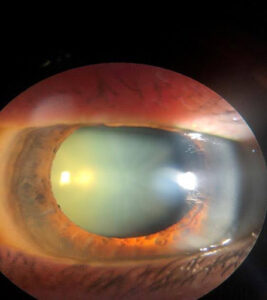
Photo above shows a cataract, the yellow haze you see within the pupil
Does cataract surgery hurt?
We use numbing drops and medication to ensure you’re comfortable and relaxed during the procedure. Most patients only notice lights changing colors. You’ll receive medication through an IV to help with relaxation and pain, but you will remain awake and breathing on your own. After surgery, mild irritation, similar to having an eyelash in your eye, is typical, but most patients don’t need more than occasional Tylenol or preservative free artificial tears to feel comfortable.
When can I have surgery on my second eye?
Usually, surgery on the second eye is scheduled two weeks after the first. If healing takes longer, we will adjust the timeline to ensure your first eye is functioning well before the second surgery.
When can I get fitted for new glasses or contacts?
You can usually be fitted for new glasses or contacts about a month after surgery on your second eye.
What about my dry eyes?
Dry eyes can impact measurements for cataract surgery. Use artificial tear drops like Systane, Refresh, or TheraTears four times daily for at a week or two prior to your preoperative appointment to improve accuracy and post-surgery comfort.
Will I need to wear glasses after cataract surgery?
- Monofocal Lens: Full time glasses are needed after surgery to see clearly at all distances.
- Monovision: One eye is set for near vision; one eye set for distance vision. You must have tried this before in contacts for this to be an option because some patients to not adapt well to this change, feel off balance, or lose their depth perception.
- Toric Lens: Corrects corneal astigmatism (where the clear covering of the eye is shaped more like a football than a basketball) to allow clearer distance vision. Post operatively, most patients can drive without glasses, and only need over the counter “cheaters” to read.
- Multifocal/Trifocal/EDOF Lens: These advanced technology lenses correct corneal astigmatism AND presbyopia at the same time as your cataract surgery, giving you the best opportunity to have freedom from glasses at distance, intermediate, and near. Not an option if you have diabetic retinopathy, macular degeneration, or other retinal issues.
- Light Adjustable Lens: These advanced technology lenses also correct corneal astigmatism and presbyopia at the same time as your cataract surgery AND are able to be adjusted with a light after surgery without the need to have further surgeries. This lens is able to give freedom for glasses at most distances and is a great option for patients who have high demands for clear vision and have other ocular conditions like previous RK, LASIK/PRK, macular degeneration or corneal issues. It does require more dilated visits and more “chair time” but is customizable to your vision preferences. It offers slightly less near vision than the multifocal lenses but does not have the risk of glare or halos or rings around lights like multifocal lenses.
When do I need cataract surgery?
Cataract surgery is a personal decision. If your vision loss begins to affect your daily life and activities, it may be time to consider surgery. However, surgery is not mandatory just because you’ve been diagnosed with cataracts.
What is cataract surgery?
Cataract surgery involves making small incisions, less than 3 mm, in the clear front part of the eye called the cornea. A specialized instrument uses sound waves to break up the cataract and remove it. The cloudy lens is then replaced with a clear artificial lens, called an intraocular lens (IOL).
When and where are my post op visits?
You will generally be seen the next day, within the next week, and about a month after surgery back at the Henry Eye Clinic. If you were referred by your optometrist, you will typically see them at their office a week after the second eye for co-management and to ensure continuity of care.
What are the risks?
Although cataract surgery is generally very safe and effective and the complication rate is less than one percent. Risks include infection, retinal swelling, loss of vision, and potential need for further surgery.
When do I need to stop wearing my contact lenses?
Stop wearing contacts two weeks before your preoperative appointment. Contact lenses can temporarily change the shape of your cornea, which can affect the accuracy of measurements used to determine your new intraocular lens power.
Can my cataract come back?
Once removed, a cataract cannot return. However, over time, the capsular bag holding your artificial lens may become cloudy, a condition called posterior capsular opacification or “secondary cataract.” This can be treated with a quick, painless outpatient laser procedure.
What are the symptoms of a cataract?
- Cloudy, blurry, or hazy vision
- Needing more light to see clearly
- Seeing rings or halos around lights
- Difficulty adjusting to different lighting conditions
- Poor night vision or trouble driving at night
- Sensitivity to light, glare, or headlights
- Vision that feels dim or dull, not improved by glasses or contacts
- Feeling as though glasses are dirty or the wrong prescription despite cleaning or replacing them
How long does surgery take?
The surgery itself takes less than 15 minutes. However, the entire process, including preparation and recovery, takes a few hours. You’ll go home the same day but will need a driver and someone to stay with you for the rest of the day.
Where is the surgery performed?
We perform surgeries at North Hills Surgical Center located at 3271 Wimberly Drive, Suite 1, in Fayetteville, Arkansas, near Washington Regional Medical Center or at the NWA Surgery Center located at 3689 N Steele Boulevard in Fayetteville.
When can I drive and go back to work?
Most patients see and feel well enough to return to work the next day and can drive if they feel safe and have legal driving vision in the non-operative eye.
What are my restrictions after surgery?
For the first week after surgery, you will sleep with an eye shield at night, do no lifting over ten pounds, wear no eye makeup, and do no vigorous exercise. For two weeks, avoid dunking your head underwater in pools or hot tubs. You can read, watch TV, and engage in most normal activities immediately but avoid rubbing your eye.
Is cataract surgery covered by my insurance?
Medicare and other insurances will only pay for the Monofocal lens option, but will allow you to pay the additional “out of pocket” charge for the other options to give you the once in a lifetime opportunity to have the best chance at freedom from glasses at the same time as your cataract surgery. You will discuss your options and preferences with your surgeon at your preoperative visit.